Original Article

Role of internet on overall development of knowledge and attitude among undergraduate, postgraduate students, and staff members in a dental institution – A questionnaire-based study

Apoorva Bhargava Daga1, Prashant Nahar2, Mohit Pal Singh2, Deeptanshu Daga2, Pallavi Sharma3, Komal Fanda3

1Department of Dentistry, Pacific Institute of Medical Sciences, Udaipur, Rajasthan, India, 2Department of OMDR, Pacific Institute of Medical Sciences, Udaipur, Rajasthan, India, 3Department of Periodontology, Himachal Dental College, Mandi, Himachal Pradesh, India

Address for correspondence: Dr. Apoorva Bhargava Daga, Department of Dentistry, Pacific Institute of Medical Sciences, Umarda, Udaipur, Rajasthan, India. E-mail: doc.apoorva.bhargava@gmail.com

Submitted: 26-May-2021,

Accepted in Revised Form: 27-Oct-2021,

Published: 29-Dec-2021

DOI: 10.4103/sidj.sidj_7_21

Saint Int Dent J 2021;5:42-8.

Copyright: © 2021 The Saint's International Dental Journal

Licence

This is an open access journal, and articles are distributed under the terms of the Creative Commons Attribution-NonCommercial-ShareAlike 4.0 License, which allows others to remix, tweak, and build upon the work non-commercially, as long as appropriate credit is given and the new creations are licensed under the identical terms.

Disclaimer:

This article was originally published by Wolters Kluwer Medknow Publications & Media Pvt Ltd and has now been officially transferred to Society of Dental Research & Education due to a change in publishing entity.


ABSTRACT

Introduction: Everyone nowadays needs access to the Internet for recreational and educational purposes. The goal of this study was to find out how undergraduate, postgraduate, and college faculty members use the Internet for various purposes.

Materials and Methods: A cross-sectional study was conducted by preparing 18 questions in 240 participants with the help of a semi-structured, pretested questionnaire, 7 closed-ended and the rest multiple-choice questionnaire containing demographic information, information related to Internet addiction test questions, undergraduate, postgraduate, and faculty members of the college were selected and evaluated.

Results and Observations: This study revealed that the Internet was used as a source of learning for all the groups. Mainly undergraduates use the Internet for entertainment and educational purposes both. Postgraduates, apart from these, also used the Internet for their research work. Staff members used it for all the reasons mentioned above and used email, learning exercises, and teaching purposes.

Conclusion: The Internet not only provides a great source of entertainment and information, but it is also essential for the exchange of information, social communication, education, banking, business, shopping, administration, and proper evaluation of data sources. It is a constantly changing phenomenon that is getting more and more ingrained into our daily life.

Keywords: Dentistry, internet, postgraduate, research, undergraduate


INTRODUCTION

Internet nowadays has become an essential part of our life both for education and social purposes. In particular, it has become an integral part of education and research, and its impact on teaching and learning is widely acknowledged.[1]

It is making substantial inroads into research, patient care education, and dissemination of health care information.[2] It has become one of the most important sources of information for students of higher education institutions worldwide by providing access to educational materials.[3]

Education and research, communication, healthcare services, online monetary transactions, trade, buying items, entertainment, and other benefits of the Internet have all been extensively investigated.[3] According to research, 73% of college students use the Internet at least once a day and spend between 1.6 and 4.5 hours a day online, preferably at night.[3]

According to the literature, the internet is fast expanding, and it has become a vital resource for patient care, evidence-based care, and the transmission of high-quality health-related information.[2] Furthermore, greater internet use allows for the transfer of patient records, online diagnosis, and distinct learning through webinars without the presence of faculty.[4-6] The internet’s widespread use in medicine has had a considerable impact on research, training, and patient care 8. Electronic learning is a flexible approach to dentistry students’ education that allows them to work at their own pace.[7-9]

Aim and objectives

  • Aim of the study was to access the importance of internet in improving the skills and knowledge among undergraduate, postgraduate, and staff members of Pacific Dental College and Hospital.

The objectives were:

  • To evaluate the most frequently used mode to operate internet

  • To evaluate the total working hours of an individual on internet

  • To evaluate the main indication of using internet

  • To evaluate that whether internet can replace the classroom teaching method.

  • To evaluate that can internet be a boon for academics and clinical practice

  • To evaluate the various communication modes through which internet is used for exchange of dental information • To evaluate that whether the information available on internet is actually reliable or not.

Study design

A questionnaire-based study on Internet use was undertaken in a dental institution with 100 undergraduate, 100 postgraduate, and 40 Pacific Dental and Hospital staff members.

MATERIALS AND METHODS

A self-administered pretested questionnaire was prepared with 18 questions to assess the role of the internet in the overall development of knowledge and attitude. Seven questions were close-ended, and the rest all had multiple choices to answer. The questionnaire was handed to all included participants before the start of the survey, and they were collected from them immediately after they completed it, which took about 10 to 20 minutes. Out of a total of 240 respondents, 40 staff members and 200 students (111 women and 89 males) participated in the survey. The purpose of the study was explained in detail to the respondents, and respondents were reminded not to write their names on the form. They were also reminded that they had to choose only one option for each question. The data were analyzed using Microsoft office excel 2007. Chi-squared test was applied, and the P<0.05, which showed that the data were significant.

DEPARTMENT OF ORAL MEDICINE AND RADIOLOGY PACIFIC DENTAL COLLEGE AND HOSPITAL UDAIPUR, RAJASTHAN

ROLE OF INTERNET ON OVERALL DEVELOPMENT OF KNOWLEDGE AND ATTITUDE AMONG UNDERGRADUATES, POSTGRADUATES STUDENTS AND STAFF MEMBERS IN A DENTAL INSTITUTION -A QUESTIONNAIRE BASED STUDY.

large

AGE (in years):………………… GENDER: MALE/FEMALE

KINDLY ANSWER THE FOLLOWING QUESTIONS

(PUT MARK ON ONLY 1 APPROPRIATE OPTION AND PREFERENCE SCORE AS 1,2,3,4,5 IN Q 4,13)

Q1. WHICH MODE DO YOU USE MOST FREQUENTLY TO ACCESS INTERNET?

large

Q2. WHICH IS THE MOST PREFERED PLACE FOR YOU TO WORK ON INTERNET?

large

Q3. FOR HOW MANY HOURS A DAY DO YOU ACCESS INTERNET?

large

Q 4 . W H AT I S YO U R I N D I C AT I O N F O R U S I N G INTERNET? (SPECIFY PREFERENCE – 1, 2, 3, 4, 5)
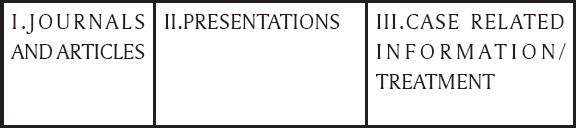
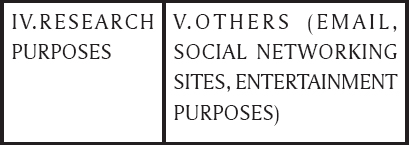
large large

Q5. WHICH OF THE FOLLOWING ARE YOU AWARE OF?
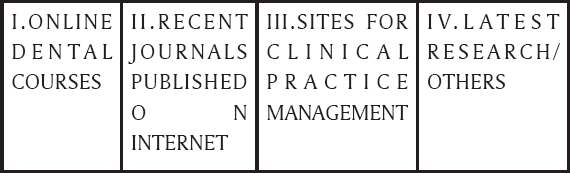
large

Q6. DO YOU ENCOUNTER PATIENTS COMING WITH KNOWLEDGE GAINED THROUGH INTERNET ABOUT DENTAL DISEASES/TREATMENT?

large

IF YES, DO YOU THINK IT CREATES HINDRANCE IN DENTIST PATIENT RELATIONSHIP and MANAGEMENT OF PATIENT?

large

Q7. DOES INTERNET IN ANY WAY IMPROVE THE TEACHING/ LEARNING SKILLS OF A TEACHER/STUDENT?

large

Q8. HOW WILL YOU RATE YOUR SKILLS IN USING INTERNET?

large large

Q9. HOW MANY YEARS EXPERIENCE DO YOU HAVE IN USING INTERNET?

large

Q 10. ARE YOU AWARE OF COMMUNICATION THROUGH INTERNET FOR EXCHANGE OF MEDICAL AND DENTAL INFORMATION?

large

IF YES, WHICH TYPE OF COMMUNICATION YOU ARE FAMILIAR WITH?

large

Q11.HOW DID YOU LEARN TO USE INTERNET?

large

Q12. WHICH WEBSITE/SEARCH ENGINES DO YOU USE MOST COMMONLY TO GAIN KNOWLEDGE?

large

Q13. WHICH OF THE FOLLOWING METHOD IS USED MORE COMMONLY FOR STUDY AND TEACHING PURPOSES?

large large

Q14. DO YOU SURF OTHER SITES WHILE USING INTERNET FOR DENTISTRY?

large

Q15. DO YOU THINK INFORMATION AVAILABLE ON INTERNET IS RELIABLE?

large

Q16. DO YOU THINK GAINING KNOWLEDGE ABOUT DENTISTRY THROUGH INTERNET IS A BOON FOR ACADEMICS and CLINICAL PRACTICE?

large

Q17. HOW WOULD YOU RATE THE QUALITY OF KNOWLEDGE GAINED BY INTERNET AS COMPARED TO TEXTBOOK and JOURNALS?

large

Q18. DO YOU THINK THE ATTAINMENT OF KNOWLEDGE THROUGH INTERNET CAN BE AN ALTERNATIVE TO CLASSROOM TEACHING, E.g. (WEBINAR)?

large

Statistical analysis

Discrete (categorical) data were summarized in number (n) and percentage (%). Categorical groups were compared by the Chi-square test. A two-tailed (α = 2) P < 0.05 was considered statistically significant. Analysis was performed on SPSS software (Window’s version 22) [Tables 1 and 2].

Table 1: Distribution of response to different questions by recruited participants

Question/response Number of participants (n=240), n (%)
Q1
 Desktop 29 (12.1)
 Laptop 92 (38.3)
 Cell phone 115 (47.9)
 Tablet 4 (1.7)
Q2
 Home 67 (27.9)
 Hostel 104 (43.3)
 College 53 (22.1)
 Work place 16 (6.7)
Q3 (h)
 <2 45 (18.8)
 2-4 60 (25.0)
 4-6 76 (31.7)
 >6 59 (24.6)
Q4
 Journals and articles 67 (27.9)
 Presentations 60 (25.0)
 Case related information/treatment 36 (15.0)
 Research purposes 35 (14.6)
 Others 42 (17.5)
Q5
 Online dental courses 82 (34.2)
 Recent journal published on internet 88 (36.7)
 Sites for clinical practice management 24 (10.0)
 Latest research/others 46 (19.2)
Q6
 Yes 208 (86.7)
 No 32 (13.3)
Q6a
 Yes 163 (78.4)
 No 45 (21.6)
Q7
 Yes 218 (90.8)
 No 22 (9.2)
Q8
 Unfamiliar 6 (2.5)
 Beginner 13 (5.4)
 Average 107 (44.6)
 Competent 78 (32.5)
 Expert 36 (15.0)
Q9 (years)
 3-4 81 (33.8)
 5-7 66 (27.5)
 7-10 41 (17.1)
 >10 52 (21.7)
Q10
 Yes 174 (72.5)
 No 66 (27.5)
Q10a
 Telemedicine 69 (28.8)
 Teleradiology 43 (17.9)
 Others 62 (25.8)
Q11
 Primary education 82 (34.2)
 Personal study/interest and experience 139 (57.9)
 Various courses 19 (7.9)
Q12
 Google 173 (72.1)
 Yahoo 14 (5.8)
 PubMed 15 (6.3)
 Other dental sites 38 (15.8)
Q13
 MS powerpoint 102 (42.5)
 MS word 24 (10.0)
 MS excel 3 (1.3)
 Internet 107 (44.6)
 Others 4 (1.7)
Q14
 Yes 194 (80.8)
 No 46 (19.2)
Q15
 Yes 189 (78.8)
 No 51 (21.3)
Q16
 Yes 207 (86.3)
 No 33 (13.8)
Q17
 At par with text 45 (18.8)
 More than text 52 (21.7)
 Less than text 89 (37.1)
 Can’t comment 54 (22.5)
Q18
 Yes 142 (59.2)
 No 98 (40.8)

Responses to different questions were summarized in number (n) and percentage (%). The distributions of Q6a and Q10a were done on 208 and 174 numbers, respectively. Q4: Others (Email, social networking sites, entertainment purposes)


Table 2: Distribution and comparison of responses to different questions among undergraduate, postgraduate students, and faculty/ staff members (n=240)

Questions/response UG (n=100), n (%) PG (n=100), n (%) Faculty/staff (n=40), n (%) χ2 P
Q1
 Desktop 17 (17.0) 10 (10.0) 2 (5.0) 34.29 <0.001
 Laptop 24 (24.0) 57 (57.0) 11 (27.5)
 Cell phone 59 (59.0) 30 (30.0) 26 (65.0)
 Tablet 0 3 (3.0) 1 (2.5)
Q2
 Home 27 (27.0) 20 (20.0) 20 (50.0) 75.32 <0.001
 Hostel 61 (61.0) 39 (39.0) 4 (10.0)
 College 12 (12.0) 36 (36.0) 5 (12.5)
 Work place 0 5 (5.0) 11 (27.5)
Q3 (h)
 <2 20 (20.0) 15 (15.0) 10 (25.0) 29.97 <0.001
 2-4 32 (32.0) 13 (13.0) 15 (37.5)
 4-6 29 (29.0) 33 (33.0) 14 (35.0)
 >6 19 (19.0) 39 (39.0) 1 (2.5)
Q4
 Journals and articles 14 (14.0) 51 (51.0) 2 (5.0) 60.89 <0.001
 Presentations 20 (20.0) 23 (23.0) 17 (42.5)
 Case related information/treatment 18 (18.0) 9 (9.0) 9 (22.5)
 Research purposes 19 (19.0) 10 (10.0) 6 (15.0)
 Others 29 (29.0) 7 (7.0) 6 (15.0)
Q5
 Online dental courses 48 (48.0) 29 (29.0) 5 (12.5) 31.10 <0.001
 Recent journal published on internet 24 (24.0) 50 (50.0) 14 (35.0)
 Sites for clinical practice management 9 (9.0) 8 (8.0) 7 (17.5)
 Latest research/others 19 (19.0) 13 (13.0) 14 (35.0)
Q6
 Yes 83 (83.0) 88 (88.0) 37 (92.5) 2.50 0.287
 No 17 (17.0) 12 (12.0) 3 (7.5)
Q6a
 Yes 67 (80.7) 74 (84.1) 22 (59.5) 9.77 0.008
 No 16 (19.3) 14 (15.9) 15 (40.5)
Q7
 Yes 99 (99.0) 81 (81.0) 38 (95.0) 20.46 <0.001
 No 1 (1.0) 19 (19.0) 2 (5.0)
Q8
 Unfamiliar 6 (6.0) 0 0 18.48 0.018
 Beginner 4 (4.0) 9 (9.0) 0
 Average 47 (47.0) 40 (40.0) 20 (50.0)
 Competent 25 (25.0) 39 (39.0) 14 (35.0)
 Expert 18 (18.0) 12 (12.0) 6 (15.0)
Q9 (years)
 3-4 63 (63.0) 18 (18.0) 0 106.75 <0.001
 5-7 32 (32.0) 23 (23.0) 11 (27.5)
 7-10 3 (3.0) 21 (21.0) 17 (42.5)
 >10 2 (2.0) 38 (38.0) 12 (30.0)
Q10
 Yes 74 (74.0) 74 (74.0) 26 (65.0) 1.35 0.508
 No 26 (26.0) 26 (26.0) 14 (35.0)
Q10a
 Telemedicine 31 (41.9) 33 (44.6) 5 (19.2) 16.05 0.003
 Teleradiology 12 (16.2) 17 (23.0) 14 (53.8)
 Others 31 (41.9) 24 (32.4) 7 (26.9)
Q11
 Primary education 29 (29.0) 40 (40.0) 13 (32.5) 7.49 0.112
 Personal study/interest and experience 60 (60.0) 52 (52.0) 27 (67.5)
 Various courses 11 (11.0) 8 (8.0) 0
Q12
 Google 63 (63.0) 78 (78.0) 32 (80.0) 17.30 0.008
 Yahoo 6 (6.0) 8 (8.0) 0
 PubMed 5 (5.0) 7 (7.0) 3 (7.5)
 Other dental sites 26 (26.0) 7 (7.0) 5 (12.5)
Q13
 MS powerpoint 48 (48.0) 38 (38.0) 16 (40.0) 28.06 <0.001
 MS word 14 (14.0) 7 (7.0) 3 (7.5)
 MS excel 1 (1.0) 1 (1.0) 1 (2.5)
 Internet 37 (37.0) 54 (54.0) 16 (40.0)
 Others 0 0 4 (10.0)
Q14
 Yes 79 (79.0) 77 (77.0) 38 (95.0) 6.35 0.042
 No 21 (21.0) 23 (23.0) 2 (5.0)
Q15
 Yes 83 (83.0) 80 (80.0) 26 (65.0) 5.69 0.058
 No 17 (17.0) 20 (20.0) 14 (35.0)
Q16
 Yes 86 (86.0) 87 (87.0) 34 (85.0) 0.11 0.949
 No 14 (14.0) 13 (13.0) 6 (15.0)
Q17
 At par with text 18 (18.0) 25 (25.0) 2 (5.0) 34.08 <0.001
 More than text 28 (28.0) 22 (22.0) 2 (5.0)
 Less than text 27 (27.0) 32 (32.0) 30 (75.0)
 Can’t comment 27 (27.0) 21 (21.0) 6 (15.0)
Q18
 Yes 73 (73.0) 59 (59.0) 10 (25.0) 27.25 <0.001
 No 27 (27.0) 41 (41.0) 30 (75.0)

Responses to different questions were summarized in number (n) and percentage (%) and compared by Chi-square test. The distributions of Q6a and Q10a among UG, PG and faculty/staff were done on 208 (UG=83, PG=88 and faculty/staff=37) and 174 (UG=74, PG=74 and faculty/staff=26) numbers, respectively. UG: Under graduate, PG: Postgraduate, Q4: Others (Email, social networking sites, entertainment purposes)
 

RESULTS AND OBSERVATIONS

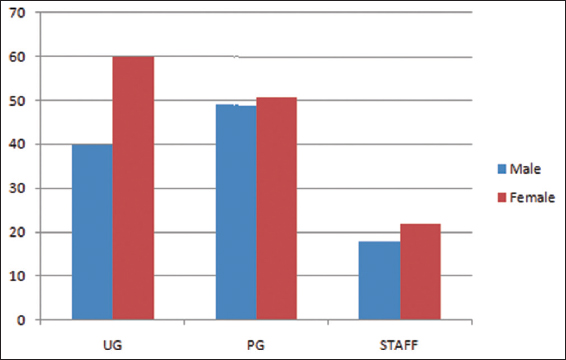
In the present study total, no of participants were 240 out of them, 100 were undergraduates, 100 were postgraduates, and 40 were staff members among 100 undergraduates, 40 were males, 60 were females among 100 postgraduates, 49 were males, 51 were females, and among 40 staff members 18 were males and 22 were females [Table 3 and Figure 1].

thumb

Figure 1: Ratio of male and female participants in all three groups


Table 3: Characteristics of recruited participants

Characteristics Number of participants (n=240), n (%)
Gender
 Male 107 (44.6)
 Female 133 (55.4)
Faculty
 UG 100 (41.7)
 PG 100 (41.7)
 Faculty/staff 40 (16.7)

Characteristics of recruited participants were summarized in number (n) and percentage (%). UG: Undergraduate, PG: Postgraduate


DISCUSSION

Advances occurring in the field of information and communication technology have revolutionized the way people think and work. At present, the Internet is making a substantial contribution to research, patient care, education, and dissemination, of health-care information.[10] The Internet is a beautiful communication tool that has undoubtedly carved a niche in dentistry; however, the same caution and criteria should be applied to evaluating information and data from Internet sources. In this situation, the academic dental community needs to ensure that electronic dental information is authentic. They should help the students to get reliable dental information from the Internet.

Data from the current study indicate that dental students and staff members use the internet to access dental information and entertainment purposes. Most postgraduate students use the internet to discover the most up-to-date research methodologies and journals, and graduate students mainly use it for recreation purposes. The study also discovered that the majority of dental students and staff members support the fact that the internet improves teaching and learning skills.[11,12]

Completed questionnaire was collected from the respondents and was analyzed through statistical analysis. It was found that among all the groups of respondents, 57% postgraduates mainly use their personal laptops to operate internet. More than 50% of PGs were operating internet mainly for finding latest journals and articles. This data is in support of the study conducted in Jordan by Spallek et al. where 91.1% of students use internet for academic purposes that is for mailing and discussion with colleagues.[11] 40% PGs were operating internet from college due to the easy availability of net, this finding is consistent with data found in an earlier study conducted in India by Grover et al. 65.38% use internet on regular basis for an average time spent was approx. 2.13 h (standard deviation1.98). Giving us an indication that internet had become an integral part in field of education.[13] Around 57% of pgs were well aware of the recent journals published on internet.[14,15] Increased use of internet by patients to enquire about the treatment modalities had led to some hindrance in clinical practice and which has led to increased demand of inappropriate care and unrealistic expectations in treatment modalities 88% pgs and 92% staff members answer yes to it.[16] According to the study 61.1% of students preferred using internet from the hostel and college this data is in consistence with study conducted by Hamissi et al. 84.1%[17] preferred university, 76.3% connected to the Internet from their home and 13 percent from others’ computers 86.8% of the students used mailing system.[15] A study conducted in Karnataka by Gupta et al. revealed 94.6% XII grade students said yes that it creates hindrance in clinical practice.[12] 80% of PGS agreed that information available on internet is reliable to an extent, according to Grover et al. 73.2% PG agree that the information available is reliable.[13]

When skills in using internet was rated, the postgraduates were found more competent than the staff and undergraduates. Majority of postgraduates were aware of communication through internet and mainly aware of telemedicine. Google was found to be the most common website used. Majority of the staff members deny that the internet cannot replace the classroom teaching, but dental students were with the fact that yes webinars can replace the classroom teaching.

CONCLUSION

Hence, we can conclude that the Internet as medium of communication is useful in medicine and has become an important means of delivering dental care. The use of the Internet is an evolving phenomenon at this stage. Its use in the dental colleges and hospitals under study is still in a state of infancy or early maturation. We can very well visualize a situation when all users will have achieved near perfection in the use of and full dependency on the Internet for their information needs. Hence, still there is a vast scope of future research in different types of users’ behavior and comparison of users’ behavior toward the Internet.[2]

Acknowledgments

My sincere thanks to all the Undergraduate, Postgraduate, and Faculties who participated in this study.

Ethics approval and consent to participate

All of the participants provided written informed consent. This study was carried out in accordance with the Helsinki Declaration and was approved by the Institutional Ethical Committee. The principal investigator is responsible for ensuring the confidentiality of the study documents and protecting the anonymity of all respondents.

Financial support and sponsorship

Nil.

Conflicts of interest

There are no conflicts of interest.

REFERENCES

1. Mahmood K. Gender, subject and degree differences in university students'access, use and attitudes toward information and communication technology (ICT). IJEDICT 2009;5:206-16. [CrossRef] [Google Scholar]

2. Ayatollahi J, Ayatollahi F, Bahrololoomi R. Using the internet among dental students in Yazd. Dent Res J (Isfahan) 2010;7:7-11. [CrossRef] [Google Scholar] [PubMed Central] [PubMed]

3. DhamnetiyaD, SinghS, JhaRP. Correlates of problematic internet use among undergraduate medical students of Delhi. BMC Psychiatry 2021;21:511. [CrossRef] [Google Scholar] [PubMed Central] [PubMed]

4. Kumar S, Tadakamadla J, Tibdewal H, Duraiswamy P Kulkarni S. Internet usage among undergraduate dental students in India. Rev Odonto ciênc 2010;25:261-5. [CrossRef] [Google Scholar]

5. Kumar M, Mondal A. A study on Internet addiction and its relation to psychopathology and self-esteem among college students. Ind Psychiatry J 2018;27:61-6. [CrossRef] [Google Scholar]

6. Chestnutt IG, Reynolds K. Perceptions of how the internet has impacted on dentistry. Br Dent J 2006;200:161-5. [CrossRef] [Google Scholar] [PubMed]

7. Maharani DA, El Tantawi M, Yoseph MG, Rahardjo A. The use of internet platforms for oral health information and associated factors among adolescents from Jakarta:A cross sectional study. BMC Oral Health 2021;21:22. [CrossRef] [Google Scholar] [PubMed Central] [PubMed]

8. RevankarAV, Gandedkar NH. Effective communication in the cyberage. Am J Orthod Dentofacial Orthop 2010;137:712-4. [CrossRef] [Google Scholar] [PubMed]

9. Andrews KG, Demps EL. Distance education in the U.S. and Canadian undergraduate dental curriculum. J Dent Educ 2003;67:427-38. [CrossRef] [Google Scholar]

10. Gupta B, White DA, Walmsley AD. The attitudes of undergraduate students and staff to the use of electronic learning. Br Dent J 2004;196:487-92. [CrossRef] [Google Scholar]

11. Spallek H, Turner SP, Donate-Bartfield E, Chambers D, McAndrew M, Zarkowski P, et al.Social media in the dental school environment, partA:Benefits, challenges, and recommendations for use. J Dent Educ 2015;79:1140-52. [CrossRef] [Google Scholar]

12. Gupta P, Gupta S, Ankola A, Jindal V. Computer use among post graduate dental students in India. J Oral Health Community Dent 2014;8:135-2. [CrossRef] [Google Scholar]

13. Grover S, Chakraborty K, Basu D. Pattern of Internet use among professionals in India:Critical look at a surprising survey result. Ind Psychiatry J 2010;19:94-100. [CrossRef] [Google Scholar] [PubMed Central] [PubMed]

14. Apuke OD, Iyendo TO. University students'usage of the internet resources for research and learning:Forms of access and perceptions of utility. Heliyon 2018;4:e01052. [CrossRef] [Google Scholar]

15. Wang L, Wang J, Wang M, Li Y, Liang Y, Xu D. Using internet search engines to obtain medical information:A comparative study. J Med Internet Res 2012;14:e74. [CrossRef] [Google Scholar] [PubMed Central] [PubMed]

16. Kumar S, Tadakamadla J, Tibdewal H, Duraiswamy P, Kulkarni S. Internet usage among undergraduate dental students in India. Rev Odonto Cienc 2010;25:261-4. [CrossRef] [Google Scholar]

17. Hamissi J, Gholami S, Hamissi H. The emerging role of computer literacy in improving the performance of dental students. Int J Collab Res Intern Med Public Health 2013;5:517-25.

