Palliative care through single visit flexible feeding aid for an infant with Pierre Robin sequence: A clinical report
Manu Rathee, Mohaneesh Bhoria, Madhuri Dua
Department of Prosthodontics, Post Graduate Institute of Dental Sciences, Pt. B.D. Sharma University of Health Sciences, Rohtak, Haryana, India
Address for correspondence: Dr. Mohaneesh Bhoria, Department of Prosthodontics, Post Graduate Institute of Dental Sciences, Pt. B.D. Sharma University of Health Sciences, Rohtak, Haryana, India. E-mail: ratheemanu@ gmail.com
DOI: 10.4103/2454-3160.177950
Saint Int Dent J 2015;1:124-6.
Copyright: © 2015 The Saint's International Dental Journal
Licence
This is an open access journal, and articles are distributed under the terms of the Creative Commons Attribution-NonCommercial-ShareAlike 4.0 License, which allows others to remix, tweak, and build upon the work non-commercially, as long as appropriate credit is given and the new creations are licensed under the identical terms.
Disclaimer:
This article was originally published by Wolters Kluwer Medknow Publications & Media Pvt Ltd and has now been officially transferred to Society of Dental Research & Education due to a change in publishing entity.
Abstract:
Pierre Robin sequence (PRS) or anomalad is one of the most readily recognized presentation, and results of the first brachial arch malformation. PRS presents a classic triad of micrognathia, glossoptosis, and cleft palate. Infants with PRS can present with varied problems, some of them emergencies. However, in infants with a complete cleft palate, most commonly encountered problems are with feeding. This article describes the clinical and laboratory procedures for construction of a feeding plate in a neonate with PRS due to the presence of a cleft palate.
Keywords: Cleft palate, feeding aid, obturator, Pierre Robin sequence
CASE REPORT
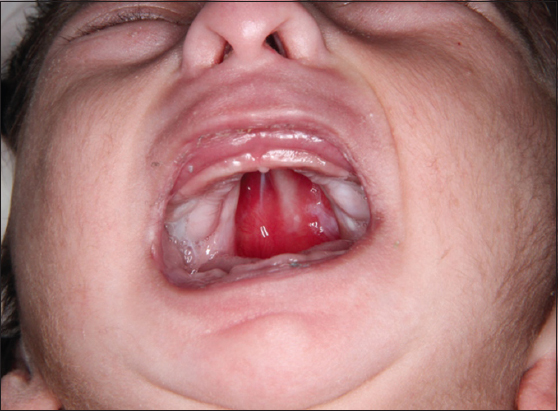
An 18-day-old male neonate was referred with complaint of difficulty feeding on milk. The medical history revealed PRS. On extraoral examination, the neonate showed characteristic receded chin with bird face appearance [Figure 1]. Intraoral examination revealed a large U-shaped palatal cleft with healthy appearing gum pads [Figure 2]. Based on these clinical findings, treatment plan was made with the purpose of improving the functional ability (suckling) as an initial prosthetic rehabilitation with an immediate approach. The parents were consented before treatment execution.
Figure 1. Lateral view of neonate with Pierre Robin sequence
Figure 2. Intraoral occlusal view showing U-shaped cleft palate
A custom-made tray was fabricated using modeling plastic impression compound (DPI Pinnacle, Mumbai, India) [Figure 3]. The flanges of the compound tray were adjusted accordingly, and retentive holes were made across the custom-made tray. Vinyl Polysiloxane putty super soft (Affinis, Coltene Whaledent Pvt. Ltd. Mumbai, India) was used for impression; constant crying and intermittent suckling during the impression procedure created the desired tissue molding. The impression was evaluated for satisfactory coverage of the vestibule and defect [Figure 4]. Once the master cast was obtained, a wire framework was adapted over the vestibular area of the master cast leaving a U-shaped frame (holder and safety mechanism) extra to the cast in the anterior region, using a 21-gauge orthodontic wire. A Bio-plastic sheet (2.00 mm × 125 mm) was adapted to master cast using vacuum former machine (Biostar VI, USA) and extra border was trimmed leaving 3–4 mm of margins. Using the roll-on technique, 3–4 mm sheet borders were well-adapted over the wire framework [Figure 5]. The completed flexible feeding aid was tried, and satisfactory outcome was noted while feeding the infant [Figure 6]. Instructions were given to the parents regarding insertion, removal, and cleaning of the feeding aid. A regular follow-up of the patient was done after 24 h, 1 week, and monthly follow-ups were scheduled.

Figure 3. Custom made tray constructed using impression compound
Figure 4. Impression made with addition silicone for accurate reproduction of features
Figure 5. Feeding aid fabricated using biocryl sheet
Figure 6. Occlusal view of the feeding aid in situ
DISCUSSION
PRS is a congenital abnormality characterized by the presence of a combination of mandibular hypoplasia, glossoptosis, and clefting of the palatal bone.[1,3] Reconstructive management of cleft lip and palate requires coordinated multidisciplinary care. Early surgical repair of the cleft lip and palate is the treatment of choice, but time of surgery depends on various vital factors including age and general health of the patient. Although various presurgical approaches to resolve feeding problems such as specially designed soft bottle with enlarged nipple were instituted, they appear not sufficient for large clefts. The palatal cleft interferes with feeding and causes regurgitation through nose. Infection of the nasopharynx is frequent. Otitis media may also be a consequence leading to hearing impairment or permanent deafness.[4,5] Hence, the construction of the palatal obturator or a feeding plate is very important until the surgical correction of the defect is carried out.
Feeding obturator is a prosthetic aid that is designed to obturate the cleft and restore separation between the oral and nasal cavities. It creates a platform against which the infant can extract milk. It also facilitates feeding, reduces nasal regurgitation, reduces choking, and shortens feeding time.[6,7] Prosthodontics care at primary level involves addressing feeding difficulties, and prevention of middle ear infections. However, multiple visits, increase laboratory time, and lengthy adjustment procedures were some of the drawbacks.[6,8.9] This article presented an alternative, easy, and convenient procedure of flexible feeding obturator fabrication which overcame the drawback of traditional materials. There were added advantages of the new materials’ flexibility for ease of placement intraorally and delivering prosthetic feeding aid at single appointment. Feeding aid constructed maintains the rigidity and adaptability of flange of obturator around gum pad area. Finally, addressing such problem at initial stage helps to boost the rehabilitation process significantly.
REFERENCES
1. Tan TY, Kilpatrick N, Farlie PG. Developmental and genetic perspectives on Pierre Robin sequence. Am J Med Genet C Semin Med Genet 2013;163C:295-305. [CrossRef] [Google Scholar] [PubMed]
2. Hegde RJ, Mathrawala NR. Pierre Robin sequence:Report of two cases. J Indian Soc Pedod Prev Dent 2010;28:326-30. [CrossRef] [Google Scholar]
3. Dennison WM. The Pierre Robin syndrome. Pediatrics 1965;36:336-41.
[Google Scholar] [PubMed]
4. Prahl-Andersen B. Dental treatment of predental and infant patients with clefts and craniofacial anomalies. Cleft Palate Craniofac J 2000;37:528-32. [CrossRef] [Google Scholar]
5. Goodacre T, Swan MC. Cleft lip and palate:Current management. Paediatr Child Health 2012;22:160-8. [CrossRef] [Google Scholar]
6. Osuji OO. Preparation of feeding obturators for infants with cleft lip and palate. J Clin Pediatr Dent 1995;19:211-4. [CrossRef] [Google Scholar] [PubMed]
7. Rathee M, Hooda A, Tamarkar A, Yadav S. Role of feeding plate in cleft palate:Case report and review of literature. Internet J Otorhinolaryngol 2009;12. [CrossRef] [Google Scholar]
8. Chandna P, Adlakha VK, Singh N. Feeding obturator appliance for an infant with cleft lip and palate. J Indian Soc Pedod Prev Dent 2011;29:71-3. [CrossRef] [Google Scholar] [PubMed]
9. Turner L, Jacobsen C, Humenczuk M, Singhal VK, Moore D, Bell H. The effects of lactation education and a prosthetic obturator appliance on feeding efficiency in infants with cleft lip and palate. Cleft Palate Craniofac J 2001;38:519-24. [CrossRef] [Google Scholar] [PubMed]